Key takeaways
- One shared stock pool is easier to manage than splitting units across FBA and a 3PL, but it needs a buffer to stop oversells.
- Each channel has its own packing slip, label and packaging expectations, so put them in writing before go-live.
- Keeping FBA for Amazon and adding a 3PL for every other channel is a common, sensible middle ground.
- At our Niles warehouse, direct-to-customer orders start at $2.75 for the first item and $0.50 per additional item.
What multichannel fulfillment actually means
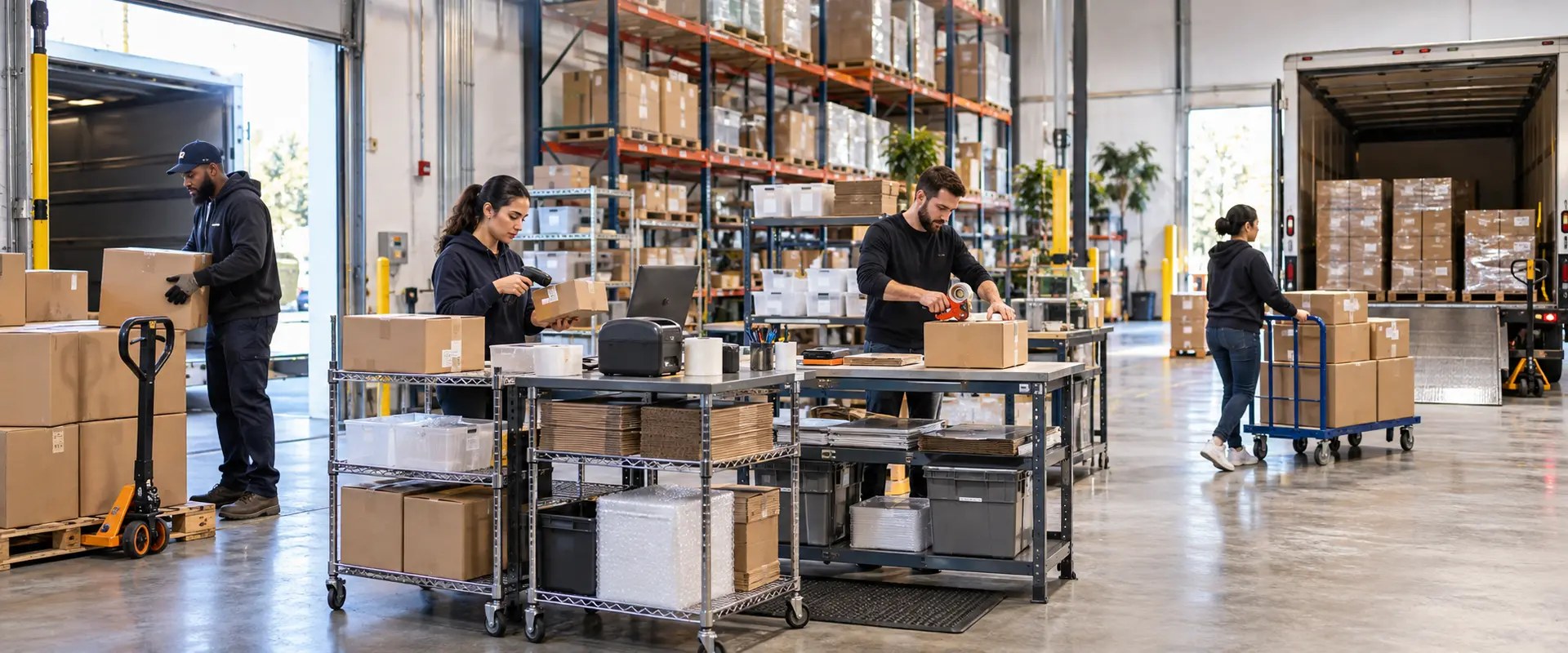
You started on Amazon. Then you opened a Shopify store, because you wanted your own customers. Then Walmart. Then somebody on your team said TikTok Shop was moving product, so you tried that too. Now orders come from four places and the garage (or the spare bedroom) is a mess. Multichannel fulfillment is the fix for that mess: one warehouse holds your stock and ships orders from every channel you sell on.
That's the whole idea. Not a new software category, not a buzzword. A single physical place where your units sit, and a team that picks, packs and ships whichever order comes in, whether it started on eBay, Etsy or your own site.
We run this kind of work every day at our warehouse in Niles, Illinois, just outside Chicago. So most of what follows comes from what we see on the packing tables, not from a slide deck.
One inventory pool or split inventory?
This is the first real decision, and it shapes everything else.
Option 1: split inventory
Most Amazon sellers already have a chunk of stock sitting in Amazon's fulfillment centers. That stock ships Amazon orders. Some sellers then put a second batch of the same SKU in a 3PL for Shopify and Walmart orders. Two pools. Two counts. Two reorder points.
It works, but it's clunky. You can run out on Shopify while 400 units sit idle in FBA (and getting those units back out of Amazon is slow and costs money). You also end up forecasting twice for the same product.
Option 2: one shared pool
Here, all non-Amazon channels draw from one stack of units in one building. Some sellers go further and ship Amazon orders merchant-fulfilled from the same pool too. Your multichannel inventory becomes one number per SKU, which is much easier to reason about when you're placing a purchase order.
If you're weighing whether Amazon orders should even go through FBA, our post on FBA vs FBM walks through that trade-off in more detail.
How orders get from each channel to the warehouse
Every channel has its own order screen. The warehouse needs to see the order, the ship-to address, the items and any special instructions. How that information gets from you to us is something we agree on during onboarding, based on your volume and how you already work. We'd rather set that up properly than promise a one-size answer here.
What matters more than the method is consistency. The warehouse needs clear SKU names that match what's physically on the shelf, a daily cutoff you both understand, and one person on your side who answers questions when an order looks off (wrong address format, a bundle nobody told us about, that kind of thing).
Labels matter too. Shipping labels have to be legally purchased and valid for the carrier and the shipment. Reused or altered labels are a hard no, for us and for the carriers.
Channel differences in packing and labeling
Selling on multiple marketplaces sounds like the same job repeated. On the floor, it isn't quite. Each channel has its own expectations, and they show up in small ways:
- Shopify and your own site usually get your branding: a custom box, an insert card, a thank-you note. See how we handle Shopify fulfillment for that kind of setup.
- Walmart and Amazon orders tend to be plainer, and the marketplace may have its own packaging and packing slip rules. Our Walmart fulfillment page covers the merchant-fulfilled side.
- TikTok Shop orders often arrive in spikes after a video takes off, so speed and stock depth matter more than fancy packaging. More on that in TikTok Shop fulfillment.
- eBay buyers care a lot about condition and protective packing, especially on used or collectible items. Here's our eBay fulfillment workflow.
- Etsy shoppers expect a handmade, personal feel. Gift notes and careful wrapping go a long way, which is why Etsy fulfillment orders often carry an extra insert.
The rules for each marketplace change, so we don't quote them as gospel here. Check the current Seller Central or Seller Center help pages for each channel, then write the packing rules into your work order so everyone works from the same sheet. One note: channel names here describe the workflows we support. They don't mean any partnership or endorsement.
Oversells, and why you need a stock buffer
Here's the problem nobody warns you about. You have 10 units. Shopify shows 10. Walmart shows 10. TikTok Shop shows 10. Three orders hit within a few minutes, on three channels, for the last few units. Somebody gets a cancellation.
Oversells hurt more on marketplaces than on your own store, because cancellations can count against your seller metrics. So most sellers keep a buffer. Say you hold back 5% to 10% of each SKU from your listings, or a fixed few units on the slower channels. When the shelf hits the buffer, the listing shows zero even though a few units are still in the building.
It feels like wasted stock. It isn't. It's insurance against the one bad week that costs you a listing. Pair it with a regular count (we do physical counts and custom inventory reports on request) and your numbers stay honest.
When to keep FBA and add a 3PL for other channels
Plenty of sellers don't want to leave FBA, and that's fine. A common setup looks like this: Amazon orders keep shipping from FBA, and a multichannel 3PL ships everything else from one pool. You keep Prime eligibility on Amazon and get proper control over your other channels.
This hybrid makes sense when:
- 01
Amazon is still your biggest channel
FBA handles that volume, and you don't want to disrupt it.
- 02
Your other channels have grown past the garage
Packing Shopify or Walmart orders yourself is eating your evenings.
- 03
You want branded packaging off Amazon
Inserts, custom boxes and gift notes are easier from a 3PL than from Amazon's network.
- 04
You want a backup
If FBA check-in slows down or a listing gets stuck, you still have sellable stock somewhere else.
A side benefit: the same warehouse can prep and send replenishment into FBA. So your supplier ships one container to one address, and the stock gets split from there.
What multichannel fulfillment costs, with real numbers
We won't quote an industry average, because nobody can verify those. Here's what one warehouse charges instead: ours. These come from our posted pricing.
- First item per order, 1-250 orders/month
- $2.75
- First item per order, 251-500 orders/month
- $2.35
- Additional item in the same order
- $0.50
- Branded insert / marketing card
- $0.20/order
- Gift note / packing slip
- $0.30/order
- Standard pallet storage
- $35/month
- Carton receiving
- $1.00/carton
Quick hypothetical. Say you ship 200 orders a month across Shopify, Walmart and Etsy, and a quarter of them have a second item. That's 200 x $2.75 = $550, plus 50 x $0.50 = $25, so $575 in pick and pack. Add two pallets of storage at $35 each and you're at $645 a month before postage, which depends on the carrier, weight and destination.
Compare that with your own time spent packing, plus the tape, the boxes and the trips to the post office. For a lot of sellers the math tips somewhere around the point where packing stops being a side task and becomes a part-time job.
Running every channel from a 3PL in Chicago
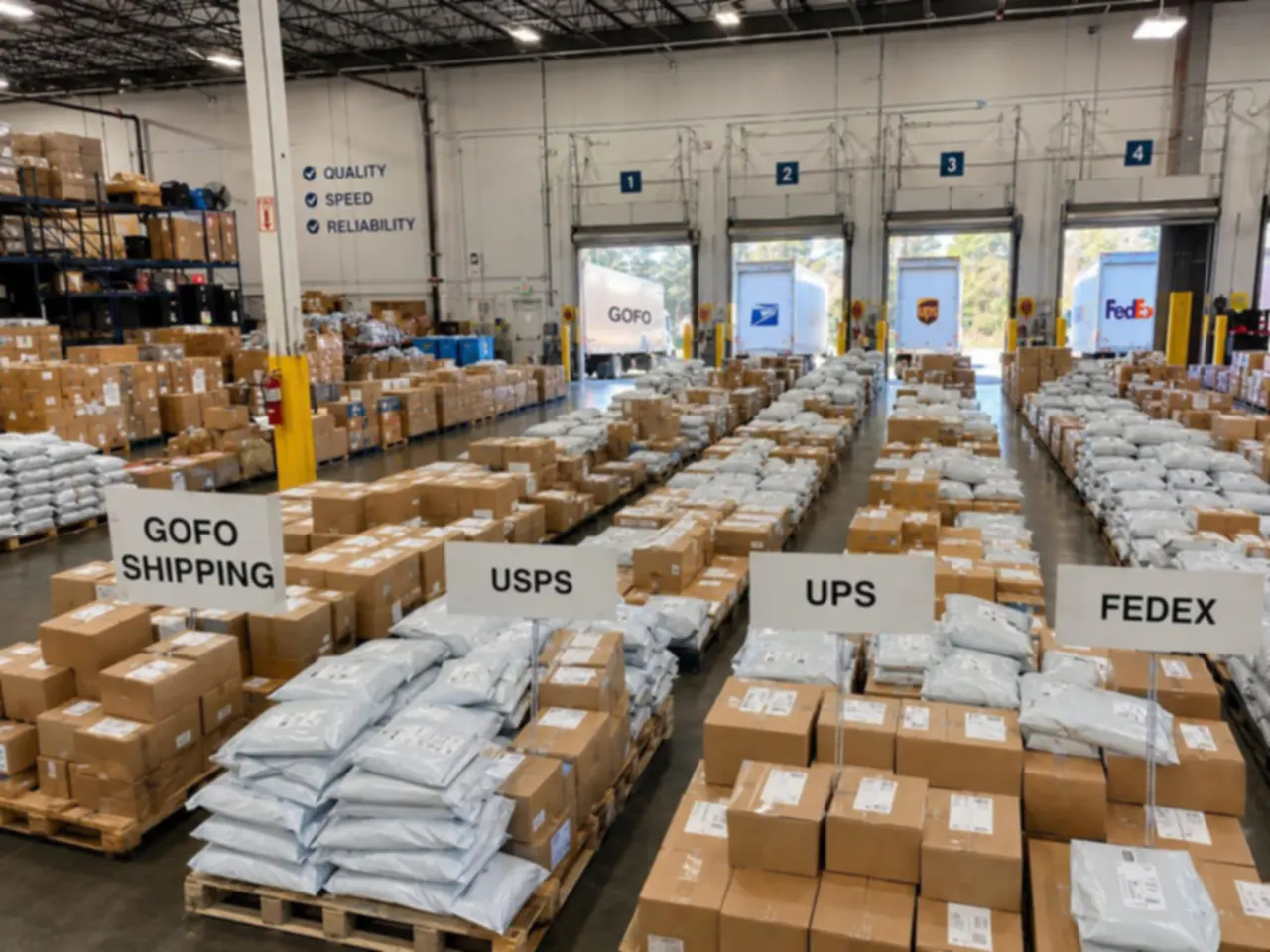
Our order fulfillment services run out of 5673 W Howard St in Niles. We process roughly 1,000+ parcels a day, and carriers (GOFO, UPS, USPS and FedEx) pick up on a schedule Monday through Saturday. Same-day fulfillment is available for qualifying orders, with capacity confirmed against your order profile.
If you're looking for a 3PL in Chicago that can hold one stock pool and ship Amazon, Shopify, Walmart, TikTok Shop, eBay and Etsy orders from it, send us your channels, SKU count and monthly order volume. We'll tell you plainly what fits and what doesn't.