Key takeaways
- Floor loading fits more cartons in the box, but every carton gets handled by hand when it lands.
- Palletized loads unload faster and with less carton damage, at the cost of some container space.
- At our Niles warehouse, a 20 ft unload runs $350 palletized vs $500-$650 floor loaded; a 40 ft runs $600 vs $750-$1,000.
- Send the packing list, carton label details and ETA before the container leaves port, not the morning it shows up.
The question your supplier is about to ask
Sooner or later, a factory rep messages you: "Floor load or pallets?" That's the floor loaded vs palletized container decision, and it matters more than most first time importers think. It changes how much fits in the box, how long the truck sits at our dock, how many cartons arrive crushed, and what you pay on the warehouse side.
Quick definitions. A floor-loaded container has cartons stacked directly on the container floor, wall to wall, often all the way to the ceiling. A palletized container has cartons built onto pallets at the factory, wrapped, and loaded as units that a forklift can pull out.
Neither one is "right." It depends on your product, your volume and what happens to the freight after it lands. We unload both kinds at our warehouse in Niles, so here's how we'd think about it.
Space: floor loading usually wins
This is the main reason sellers floor load. Pallets take up room. The wood itself has height, and pallets rarely match the container's inside dimensions perfectly, so you end up with gaps along the walls and dead air above each stack.
When cartons go straight on the floor, the crew at origin can fill those gaps. For light, bulky product (think pillows, plastic storage bins, pet beds) that extra space can be the difference between one container and two. And ocean freight is priced per container, not per carton.
So if your landed cost per unit is tight, floor loading is often how importers squeeze it. Just know the bill doesn't disappear. Part of it moves to the warehouse end.
Container unloading: labor and time at the dock
Here's where the two options split hard.
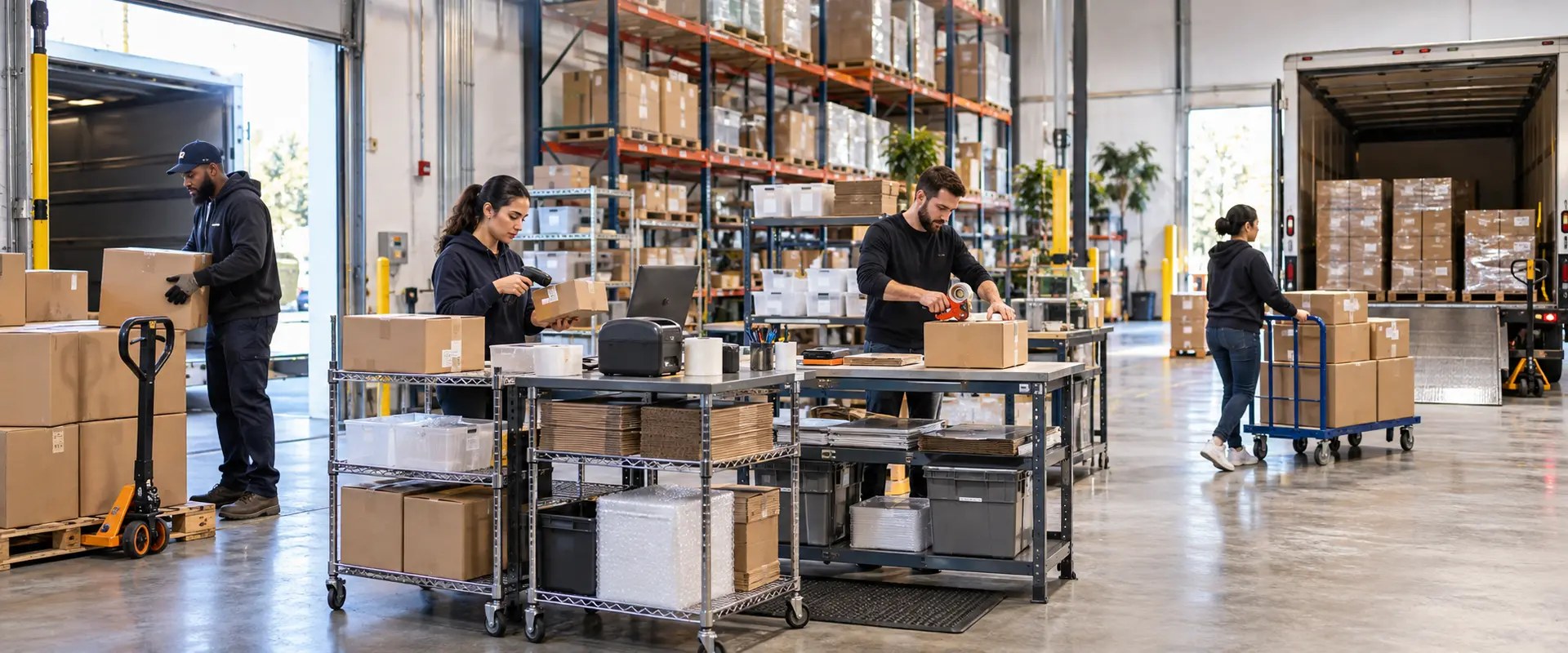
A palletized container is mostly forklift work. Pull a pallet, stage it, pull the next one. A typical 20 ft palletized load comes off fairly quickly once the doors are open.
A floor-loaded container is hand work. Someone climbs in and moves every single carton, one at a time, onto a pallet or a conveyor. Heavy cartons slow it down. Mixed SKUs slow it down more, because the crew has to separate them as they go instead of building one tall stack of the same item. That's the real cost of devanning a floor load: hours of people lifting boxes.
Time matters for another reason too. The drayage driver who brings the container usually has a window before waiting time starts costing money. That's between you, your forwarder and the trucking company, but a long hand unload is one of the ways people run past it.
Damage risk
Floor-loaded cartons shift during the ocean leg. The bottom rows carry the full weight of everything above them for weeks. What we see on the floor fairly often: corner crush on the lowest layers, split tape, and the odd carton that gave up somewhere in the Pacific.
Palletized freight isn't immune (a badly wrapped pallet can lean or collapse), but stretch-wrapped pallets hold their shape better and get touched by people far less. Fewer touches, fewer drops.
If your product is fragile, high value, or sold in retail packaging that has to look new, that's a strong argument for pallets even if you lose some space.
What container unloading costs at one Chicago-area warehouse
We'd rather show real numbers than vague ranges, so here are our posted rates for container unloading in Chicago at our Niles warehouse:
- 20 ft palletized unload
- $350/container
- 20 ft floor-loaded unload
- $500-$650/container (carton count and SKU complexity)
- 40 ft palletized unload
- $600/container
- 40 ft floor-loaded unload
- $750-$1,000/container (complex or mixed loads at the upper end)
- Container sort by SKU
- +$0.15-$0.30/unit, if the floor load needs separation or counting
- Pallet build / palletization
- $30/pallet + $1/carton
- Standard pallet storage
- $35/pallet/month
Our container unloading cost doesn't include drayage, port fees or customs. Those stay with your own customs broker and freight forwarder.
A hypothetical 20 ft comparison
Say (purely as an example) you're importing 500 cartons of one product, 10 units per carton, 5,000 units total. You plan to store it all for a month on 10 pallets. Freight, drayage and duties are left out because they don't come from us.
- Palletized, arriving on 10 pallets: $350 unload + 10 pallets x $35 storage = $700 for the first month.
- Floor loaded: $500-$650 unload + palletization (10 x $30 + 500 x $1 = $800) + 10 pallets x $35 storage = $1,650-$1,800 for the first month.
- Floor loaded with mixed or unclear SKUs that need sorting: add 5,000 units x $0.15-$0.30 = $750-$1,500.
That is the floor loaded vs palletized container math on our side. Now compare it to what floor loading saved you on ocean freight. If the extra space let you skip a second container, floor loading probably still wins. If everything fit either way, pallets were the cheaper call. The full rate sheet is on our pricing page, and your actual quote depends on the packing list.
After the unload: sort, palletize, then store or ship
Getting cartons out of the box is step one. What comes next depends on where the inventory is headed.
- 01
Count and check
Cartons are counted against your packing list during inbound receiving, and damage gets flagged right away while the container paperwork is still fresh.
- 02
Sort by SKU
Floor loads often mix items in the same rows. Those cartons get separated so each SKU sits together. Palletized loads usually skip most of this if the factory built single-SKU pallets.
- 03
Build pallets
Loose floor-loaded cartons get stacked onto pallets and wrapped so they can go on a rack or onto a truck.
- 04
Store or move on
Pallets go into warehouse storage, or get cross-docked straight out to Amazon, Walmart, a retailer or another location.
If most of the container is leaving within a day or two, read our explainer on what cross docking is. If it's staying a while, our breakdown of pallet storage cost shows how monthly fees add up.
Floor loaded vs palletized container: how to decide
A few patterns we'd use as a starting point:
- Light, bulky, low-value product, one or two SKUs: floor load. The space savings are real and the unload is simple.
- Heavy cartons, fragile items or retail-ready packaging: palletize. Damage and labor eat the savings.
- Many SKUs in one container: palletize by SKU if the factory can, or expect a sorting charge on a floor load.
- Freight going straight back out (cross-dock to FBA or retail): pallets usually move faster, and speed is the whole point.
- Long-term storage: either works, but a floor load will need palletization before it can be racked.
One more thing. If you do choose pallets, ask the supplier which pallet size and height they'll use and make sure they wrap them properly. A pallet that falls apart in the container is basically a floor load with splinters.
What to send the warehouse before the container arrives
Most painful unloads aren't caused by the loading method. They're caused by surprises. Send these ahead of time:
- The packing list: SKUs, carton count per SKU, units per carton, carton weight and dimensions.
- How cartons are labeled (SKU on the side? only a factory code?) and a photo if you have one.
- Floor loaded or palletized, plus pallet count if palletized.
- Container size, container number and the ETA your forwarder gives you.
- What happens next: store, palletize, cross-dock, or a mix, and where each part is going.
New accounts also need to finish onboarding and verification before anything ships to us. Once that's done and inbound instructions are confirmed, we can plan the dock time. For the bigger picture, see our 3PL warehousing in Chicago overview, or our Illinois warehouse page if you sell from elsewhere in the state.